Ford Escape: Parking Aids / Rear Parking Aid
(If Equipped)
What is the Rear Parking Aid
Rear parking sensors detect objects behind your vehicle when in reverse (R).
Rear Parking Aid Limitations
There is a decreased coverage area at the outer corners.
When using a programmed MyKey, you cannot switch the rear parking aid off.
The rear parking aid sensors are active when your vehicle is in reverse (R) and the vehicle speed is less than 3 mph (5 km/h).
The sensor coverage area is up to 71 in (180 cm) from the rear bumper.
The rear parking aid detects large objects when you shift into reverse (R) and any of the following occur:
- Your vehicle is moving backward at a low speed.
- Your vehicle is stationary but an object is approaching the rear of your vehicle at a low speed.
- Your vehicle is moving backward at a low speed and an object is moving towards your vehicle, for example another vehicle at a low speed.
Locating the Rear Parking Aid Sensors
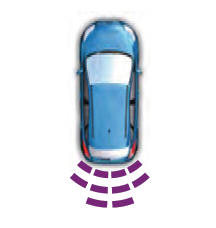
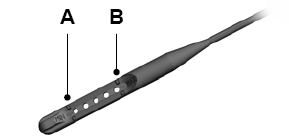
The rear parking aid sensors are in the rear bumper.
Rear Parking Aid Audible Warnings
A warning tone sounds when your vehicle approaches an object. As your vehicle moves closer to an object, the rate of the tone increases. The warning tone continuously sounds when an object is 12 in (30 cm) or less from the rear bumper.
If your vehicle remains stationary for a few seconds, the audible warning turns off. If your vehicle moves backward the tone sounds again.
Note: When the parking aid system sounds a tone, the audio system could reduce the set volume.
 Parking Aid Precautions
WARNING: To help avoid personal
injury, always use caution when in
reverse (R) and when using the sensing
system.
WARNING: The system may not
detect objects with surfaces that absorb
reflection...
 Front Parking Aid
(If Equipped)
What is the Front Parking Aid
Front parking sensors detect objects in
front of your vehicle.
Front Parking Aid Limitations
The front parking aid sensors are active
when your vehicle is in any position other
than park (P) and the vehicle speed is less
than 5 mph (8 km/h)...
Other information:
Ford Escape 2020-2026 Owners Manual: Checking the Coolant
When the engine is cold, check the concentration and level of the coolant at the intervals listed in the scheduled maintenance information. Note: Make sure that the coolant level is between the minimum and maximum marks on the coolant reservoir. Note: Coolant expands when it is hot...
Ford Escape 2020-2026 Service Manual: Diagnosis and Testing - Instrument Panel and Interior Switches Illumination
Diagnostic Trouble Code (DTC) Chart Diagnostics in this manual assume a certain skill level and knowledge of Ford-specific diagnostic practices. REFER to: Diagnostic Methods (100-00 General Information, Description and Operation). Diagnostic Trouble Code Chart Module DTC Description Action BCM B1315..
Categories
- Manuals Home
- 4th Generation Ford Escape Owners Manual
- 4th Generation Ford Escape Service Manual
- Symbols Glossary
- Adjusting the Headlamps
- Removal and Installation - All-Wheel Drive (AWD) Module - 1.5L EcoBoost (132kW/180PS) – I3 (Y1)/2.0L EcoBoost (177kW/240PS) – MI4
- New on site
- Most important about car
Engine Oil
Engine Oil Dipstick Overview