Ford Escape: Fuel System - General Information / Description and Operation - Fuel System - Overview
Overview
NOTICE: Repairs of the fuel system are to be achieved only by replacement of the failed component(s). Repair of a fuel system component should not be attempted.
NOTICE: If directed during assembly of fuel system components, lubricate any seal(s) only with specified material. Failure to follow this instruction may result in seal failure and fuel leakage.
The fuel system consists of:
- Fuel, vapor and brake tubes in an integrated bundle assembly.
- A saddle type fuel tank.
- Quick connect fuel and vapor tube couplings.
- A fuel tank filler pipe assembly, which cannot be modified in any way, that also contains a restrictor plate to permit only unleaded fuel to be pumped into the tank.
- An Easy Fuel™ (capless) fuel tank filler pipe assembly, which cannot be modified in any way and is serviced only by the installation of a new fuel tank filler pipe assembly.
- A supplemental refueling adapter located in the luggage compartment.
- Fuel Pump Control Module is located in luggage compartment .
- A non-serviceable fuel level sender located on the RH side of the fuel tank.
- A mechanical returnless fuel system (MRFS)
-
A Fuel Pump (FP) module containing:
- An electric fuel pump supplying fuel under pressure to the fuel rail.
- The fuel level sensor.
- A check valve which maintains system pressure after the pump is shut off.
- A pressure relief for overpressure protection in the event of restricted fluid flow.
- A lifetime fuel filter providing filtration to protect the fuel injectors from foreign material.
Fuel Pump Shut-off Feature
NOTE: Refer to the Description and Operation, Intelligent Access with Push Button Start in Section 419-01A to review the procedures for achieving the various ignition states (ignition OFF, ignition in ACCESSORY, ignition ON and ignition START) on vehicles with this feature.
In the event of a moderate to severe collision, the vehicle is equipped with a Fuel Pump and Sender Shut-off Feature that is initiated by the event notification signal.
The event notification feature provides other vehicle subsystems with information pertaining to restraint system deployment or fuel cutoff status. When an impact occurs which exceeds a predetermined threshold, the RCM sends a signal on a dedicated circuit to the BCM . The BCM then sends a signal on a second hard-wired circuit to the PCM , which initiates fuel cut-off and disables the fuel system.
Should the vehicle shut off after a collision due to this feature, the vehicle may be restarted by first turning the ignition to the OFF position and then turn the ignition to the ON position. In some instances the vehicle may not start the first time and may take one additional ignition cycle.
 Specifications
Item
Specification
Fuel Tank Capacity - PHEV
11.20
gal (
42.4
L)
Fuel Tank Capacity - HEV
14...
 Diagnosis and Testing - Fuel System
Diagnostic Trouble Code (DTC) Chart
Diagnostics in this manual assume a certain skill level and knowledge of Ford-specific diagnostic practices.REFER to: Diagnostic Methods (100-00 General Information, Description and Operation)...
Other information:
Ford Escape 2020-2026 Service Manual: Description and Operation - Complete Panel Replacement/Partial Replacement
Partial Replacement Item Description 1 Sectioning area 2 Manufacture weld joint Decision Criteria The following points a crucial to the decision of complete or partial replacement of the part(s)...
Ford Escape 2020-2026 Service Manual: Diagnosis and Testing - Rear Drive Halfshafts
Preliminary Inspection Visually inspect the CV joints, housing, boots, and clamps for obvious signs of mechanical damage. If an obvious cause for an observed or reported concern is found, correct the cause (if possible) before proceeding to the next step If the cause is not visually evident, verify the symptom and REFER to Symptom Chart: NVH...
Categories
- Manuals Home
- 4th Generation Ford Escape Owners Manual
- 4th Generation Ford Escape Service Manual
- Drive Modes
- Symbols Glossary
- General Procedures - Transmission Fluid Level Check
- New on site
- Most important about car
Under Hood Fuse Box
Locating the Under Hood Fuse Box
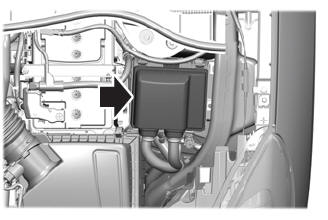
Accessing the Under Hood Fuse Box