
Ford Escape 2020-2026 Service Manual / Powertrain / Engine / Engine Cooling / Removal and Installation - Radiator
Ford Escape: Engine Cooling / Removal and Installation - Radiator
Special Tool(s) / General Equipment
| Hose Clamp Remover/Installer |
Removal
NOTE: Removal steps in this procedure may contain installation details.
-
Remove the condenser outlet line.
Refer to: Condenser Outlet Line - 2.5L Duratec – Hybrid (121kW/164PS) (BG) (412-00 Climate Control System - General Information, Removal and Installation).
-
Drain the cooling system.
Refer to: Engine Cooling System Draining, Vacuum Filling and Bleeding (303-03C Engine Cooling, General Procedures).
-
Drain the electric powertrain cooling system.
Refer to: Cooling System Filling and Bleeding (303-03D Electric Powertrain Cooling - Hybrid Electric Vehicle (HEV), General Procedures).
-
Remove the cooling fan motor and shroud.
Refer to: Cooling Fan Motor and Shroud (303-03C Engine Cooling, Removal and Installation).
-
Release the clamp and disconnect the upper radiator hose.
Use the General Equipment: Hose Clamp Remover/Installer
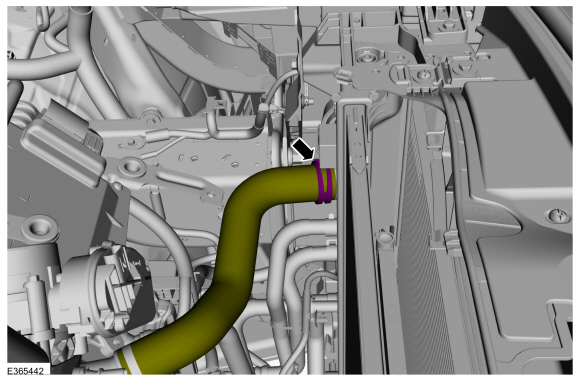 |
-
Remove the transmission fluid cooler tubes.
Refer to: Transmission Fluid Cooler Tubes (307-02B Transmission Cooling - Automatic Transmission – HF45, Removal and Installation).
-
Release the clamp and disconnect the radiator vent hose.
Use the General Equipment: Hose Clamp Remover/Installer
.jpg) |
-
Remove A/C compressor outlet line.
Refer to: Air Conditioning (A/C) Compressor Outlet Line - 2.5L Duratec – Hybrid (121kW/164PS) (BG) (412-00 Climate Control System - General Information, Removal and Installation).
-
NET88
NOTE: Make sure to cover any open ports to prevent debris from entering the system.
Remove the nut and disconnect the A/C compressor inlet line from the A/C compressor.
Torque: 159 lb.in (18 Nm)
.jpg) |
-
-
Release the clamp and disconnect the lower radiator hose.
Use the General Equipment: Hose Clamp Remover/Installer
-
Disconnect the quick connect hose coupling.
-
Release the clamp and disconnect the lower radiator hose.
.jpg) |
-
Disconnect the quick connect hose couplings.
.jpg) |
-
Remove the coolant pump.
Refer to: Coolant Pump (303-03C Engine Cooling, Removal and Installation).
-
Disconnect the quick connect hose coupling.
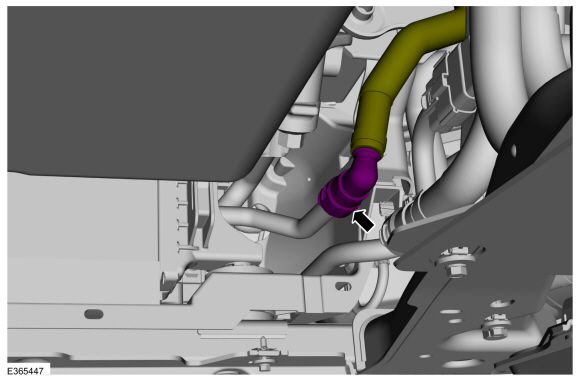 |
-
NOTICE: Take extra care not to damage the clips.
Remove the clips, the radiator support upper insulator frames and the isolators.
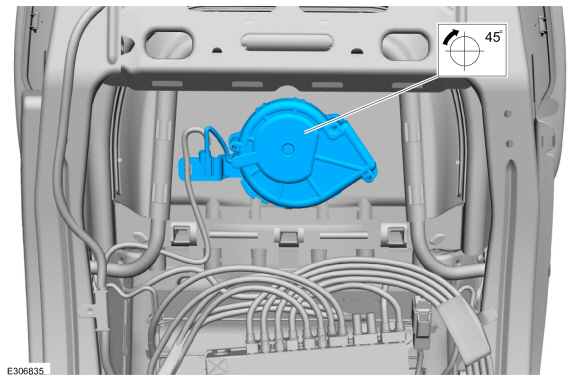 |
-
NOTICE: Take extra care not to damage the component.
NOTE: All components are not shown for clarity.
-
Lift the radiator out of the insulators.
-
Remove the radiator, A/C condenser, transmission oil cooler and auxiliary radiators assembly from below the vehicle.
-
Lift the radiator out of the insulators.
.jpg) |
-
-
Release the tabs and remove the A/C condenser.
-
Remove the bolts and the high voltage battery radiator.
Torque: 71 lb.in (8 Nm)
-
Release the tabs and remove the A/C condenser.
.jpg) |
-
Release the tabs and remove the transmission oil cooler.
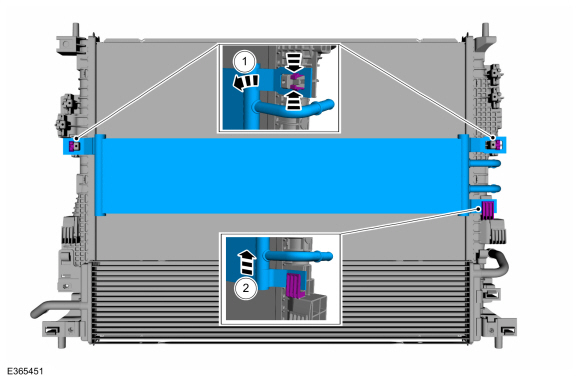 |
-
Release the tabs and remove the electric motor electronics radiator.
.jpg) |
Installation
-
To install, reverse the removal procedure.
-
Install and lubricate new condenser fitting O-ring seals.
Refer to: Specifications (412-00 Climate Control System - General Information, Specifications).
-
Fill and bleed the cooling system.
Refer to: Engine Cooling System Draining, Vacuum Filling and Bleeding (303-03C Engine Cooling, General Procedures).
-
Fill and bleed the electric powertrain cooling system.
Refer to: Cooling System Filling and Bleeding (303-03D Electric Powertrain Cooling - Hybrid Electric Vehicle (HEV), General Procedures).
-
Check and fill the transmission fluid as necessary.
Refer to: Transmission Fluid Level Check (307-01B Automatic Transmission - Automatic Transmission – HF45, General Procedures).
 Removal and Installation - Heater Hoses
Special Tool(s) /
General Equipment
Hose Clamp Remover/Installer
Removal
NOTE:
Removal steps in this procedure may contain installation details...
 Removal and Installation - Thermostat
Special Tool(s) /
General Equipment
Hose Clamp Remover/Installer
Removal
NOTE:
Removal steps in this procedure may contain installation details...
Other information:
Ford Escape 2020-2026 Service Manual: General Procedures - Air Conditioning (A/C) System Leak Test Using Forming Gas
Special Tool(s) / General Equipment Forming Gas Pressure Gauge and Leak Detector Materials Name Specification Forming Gas - Leak detection All vehicles NOTE: Use a Rotunda-approved Forming Gas A/C System Dealership Leak Detection Service Kit that meets SAE J2790...
Ford Escape 2020-2026 Service Manual: Removal and Installation - Roof Opening Panel Glass
Removal NOTE: This procedure is for the roof opening panel sliding glass only. Open the roof opening panel glass slightly to gain access to the roof opening panel glass screws. If closed, open the roof opening panel shield...
Categories
- Manuals Home
- 4th Generation Ford Escape Owners Manual
- 4th Generation Ford Escape Service Manual
- General Procedures - Brake Service Mode Activation and Deactivation
- Drive Modes
- Electric Parking Brake
- New on site
- Most important about car
Under Hood Fuse Box
Locating the Under Hood Fuse Box
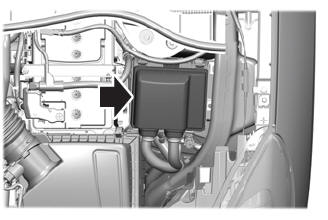
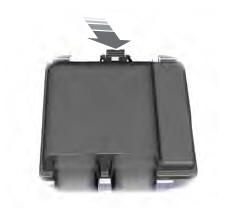
Accessing the Under Hood Fuse Box

Copyright © 2026 www.fordescape4.com